Most window coverings sold in Southern California never see a local shop floor. They arrive in a carton from a catalog, cut to a size chart, and hung on openings that were never in the same room as the people who built them. That supply chain is fine for a disposable shade. It is a poor way to buy interior shutters, which are millwork: hinged, louvered, sized to a specific frame, and meant to last as long as the window they sit on.
San Diego is unusual in that it still has a factory-town option. Interior shutters can be manufactured here, by a family company that has been doing it since 1950, for houses and for hospitality rooms that cannot accept a generic import. The difference is not a slogan about shopping local. It is who measures the opening, who mills the panel, and who is still in town if a louver needs to be remade.
A factory in the same county as the window
When shutters are made in San Diego, the manufacturing jobs stay in San Diego. That is the plain version of the story, and it is the one a buyer can verify by walking into a shop instead of tracking a container. A family-owned maker that has been on this work since 1950 is not a pop-up storefront in front of an overseas line. The panels come off a local floor. The design consult happens with someone who already knows what western light does to a living room in Point Loma and what steam does to a bath in North Park.
Imported coverings optimize for a size grid. Local manufacturing optimizes for the opening in front of you. Those are different products even when they are both white and both have louvers. One is a commodity. The other is a custom interior finish that happens to hang on glass.
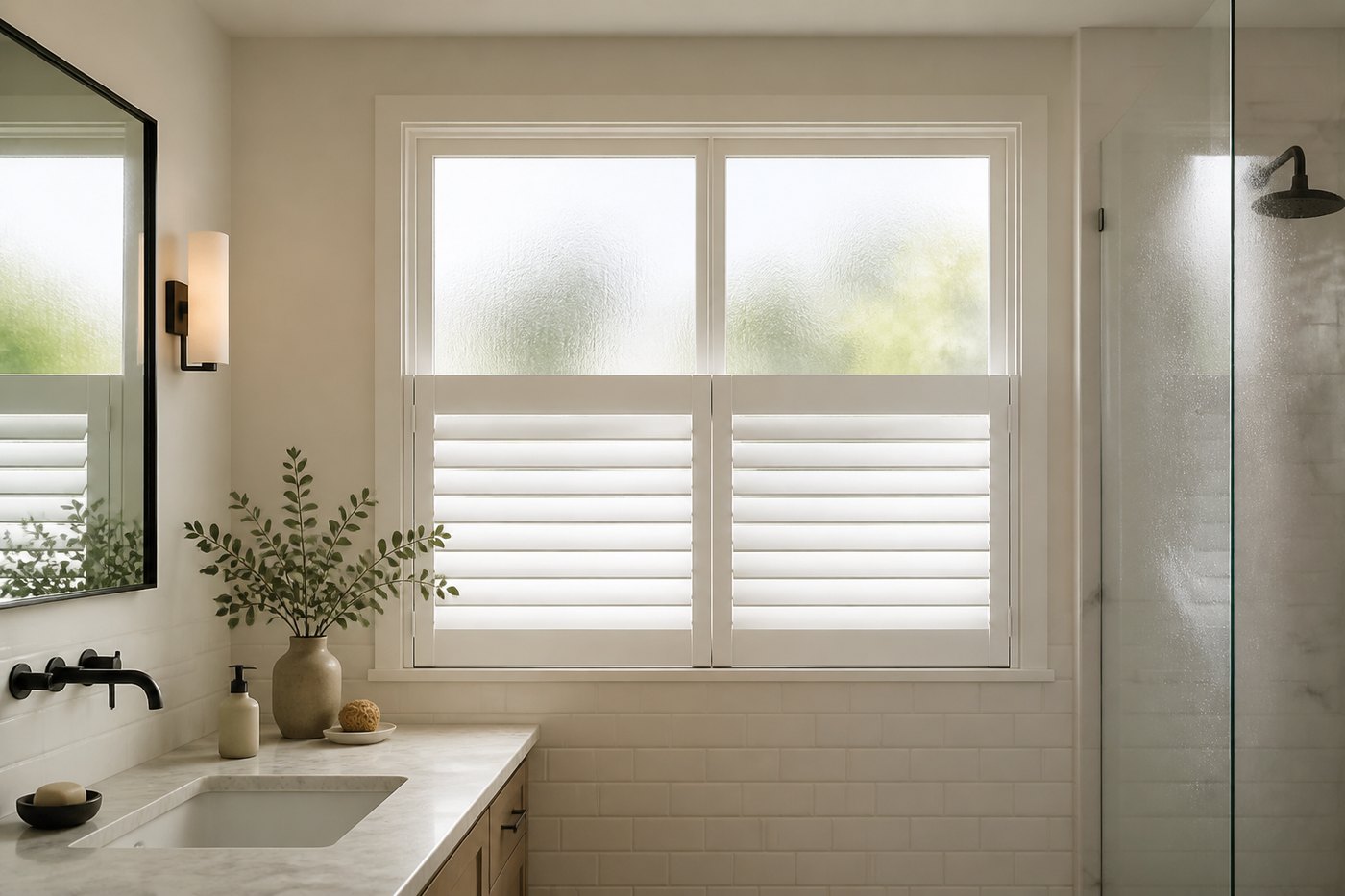
What local manufacturing changes on the panel
A shutter that is built here can be specified as vinyl, polyclad, or basswood without forcing every room onto one imported SKU. Vinyl is a honeycombed product for high-moisture rooms. Polyclad is a rigid polyvinyl surface clad over hardwood — the premier plantation-style interior, sold as resistant to scratch, dent, fade, and peel, and paint-free. Basswood is kiln-dried clear wood, milled with a beaded groove at the stiles and rails. Those three constructions exist because rooms differ. An import line that offers one polymer panel in three widths is not the same offering.
Lead time is part of the manufacturing story, not a footnote. Most orders take six to eight weeks. That is the cost of building the panel rather than pulling a box. Installation can be DIY or professional; a crew can finish in as little as a day once the order arrives. Free design consultations sit at the front of that calendar. They are how a local shop maps product to patio, living room, bathroom, kitchen and dining, and sunroom before anyone cuts wood or polymer.
The address is not a P.O. box. The manufacturer sits at 9825 Carroll Centre Rd, Suite 400, San Diego, CA 92126, and answers the phone at 1-619-276-6722. You can stand in the same county as the floor that will mill the stiles. That is a different buying process from clicking a size on a national site and hoping the returns policy is kind.
A hospitality job is a useful test
Custom work shows up most clearly when the client cannot accept a catalog panel. The Hotel del Coronado asked for custom shutters in nearly 100 guest rooms. That is a historic property with distinctive openings, privacy requirements, and a need for panels that look like they belong in the building rather than like they were dropped in from a big-box aisle. A local manufacturer that can take that job is in a different category from an importer of generic coverings.
A house is smaller than a hotel, but the test is the same. Does the maker design for the opening, or does the opening have to accept whatever shipped? Local manufacturing is the first answer. An imported covering is the second, and it is the answer you get when the only variable you optimize is unit price on the day of purchase.
Climate is not a catalog footnote
San Diego is easy on heating bills and hard on materials that hate sun, salt air, and moisture. A living room on the west side of a house takes glare and heat in the afternoon. A bathroom takes steam whether the house is a mile from the water or inland. A sunroom exists to gather light and then has to give it back in a controlled way. Vinyl in the wet rooms, polyclad on the high-handling plantation openings, basswood where the interior is meant to read as wood: that map is a climate map, not a style quiz.
Generic imports are rarely designed around that map. They are designed around a warehouse. You can hang them. You may even like them for a year. What you cannot do is walk back to the mill and ask for a matching panel when a door is replaced, or when a louver is damaged, without hoping the overseas line still runs the same profile. Local manufacturing is a spare-parts and a matching-parts story as much as it is a first-order story.
Jobs, consults, and the long life of millwork
Choosing a locally made shutter is a labor choice. The people who mill, inspect, and hang the work live in the same metro as the house. That is the community argument, and it is grounded in how the company describes itself: family-owned, manufacturing in San Diego, contributing to local jobs rather than to a distant assembly line. It is also a quality-control argument. Defects get handled by the shop that built the panel, not by a ticket queue in another time zone.
Shuttermart is the local example, not the only window covering on earth. It is the example that still makes vinyl, polyclad, and basswood interiors in San Diego and will sit with a homeowner or a remodeler before the six-to-eight-week clock starts. If the alternative is a generic imported covering, the comparison is not brand versus brand. It is a factory in Mira Mesa versus a carton.
None of that requires invented awards, review counts, or rebate figures. The facts that matter are the ones on the About page and the product pages: since 1950, family-owned, manufactured here, three constructions, free design consults, DIY or professional install, most orders in six to eight weeks, and a documented custom job at the Hotel del Coronado for nearly 100 guest rooms. That is enough to decide whether you are buying millwork or buying a carton.
The bottom line
Interior shutters are custom millwork for glass. Buying them from a San Diego manufacturer means the panel is built for the opening, the materials can be mixed by room, and the jobs stay in the county. Buying a generic imported covering means you accept a size chart and a supply chain you cannot visit. If the house is going to live with those louvers for decades, the factory-town option is the one that still has a door on Carroll Centre Road.